
When billing breaks, look at the Business Partner: a technical trace through SD master data
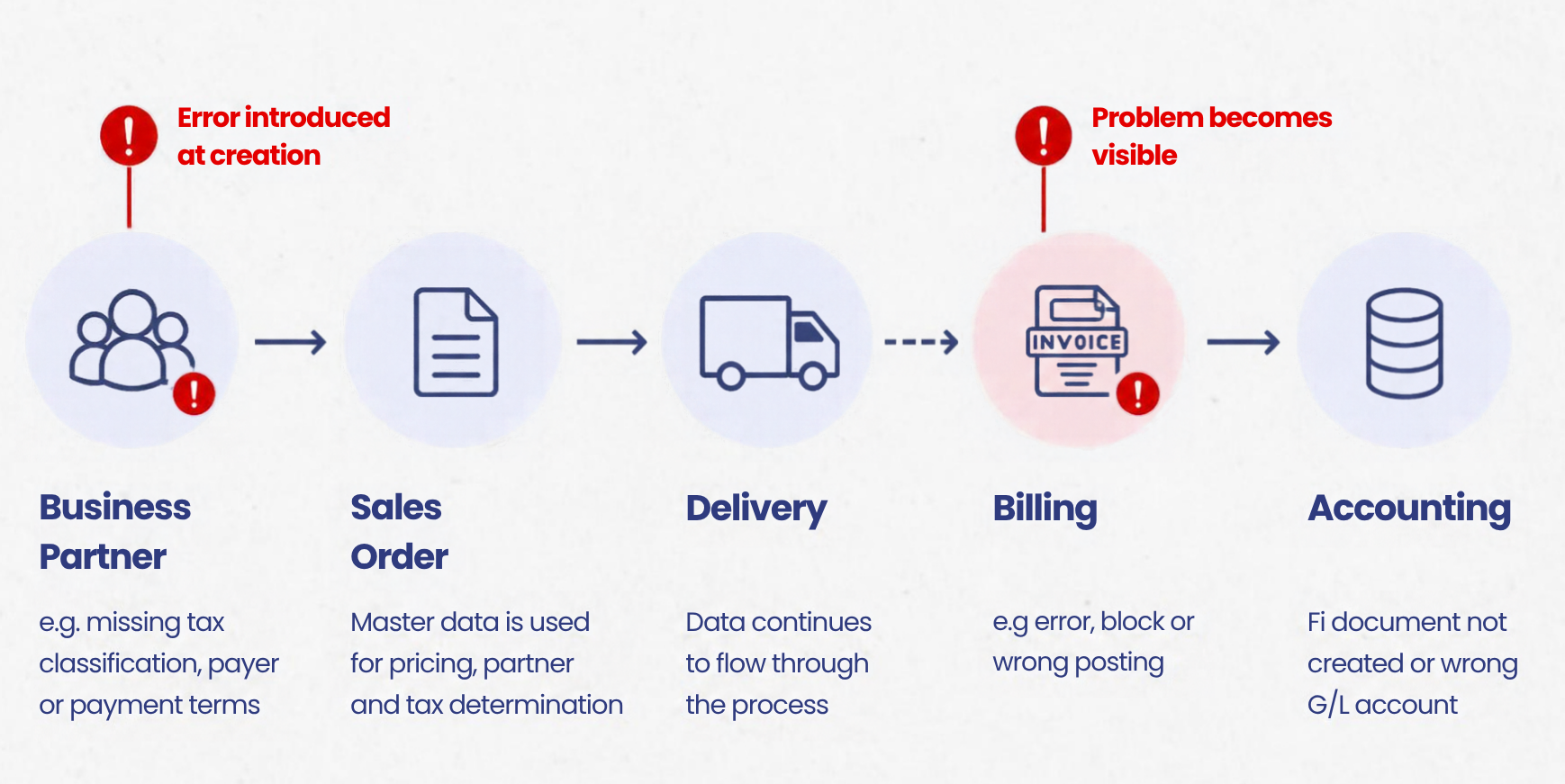
Most articles about billing errors stay at the level of "improve your data quality." That advice is true nut not very usefully functionally. If you work in an SAP SD landscape, you want to know which data, in which object, tends to break which step of the billing flow, because that's the level at which you can act on it.
The claim remains: a large share of what billing teams treat as billing errors are Business Partner errors that were introduced at master-data creation and stayed invisible until billing became the first transaction to exercise every relevant field at once.
The symptom, stated technically
The recurring failures tend to cluster into a few groups. Invoices that won't release to accounting:
• Billing document exists but the FI follow-on document doesn't, so revenue is recognized nowhere.
• Invoices that post with the wrong output tax, or fail with a tax-code-to-G/L-account error.
• Invoices raised against the wrong payer, so payment terms and dunning are wrong downstream.
• Billing splits that shouldn't happen, producing several invoices where the customer expected one.
• Invoices that never physically reach the customer because output determination didn't fire.
Each of these usually gets triaged as its own ticket. Comparatively few of them originate in billing configuration.
The source: the Business Partner is the single object every one of these reads
In S/4HANA there is no independent customer master to "get wrong" in isolation. The Business Partner is the customer master. BUT000 is the leading table, and the classic customer tables (KNA1, KNB1, KNVV) are kept in sync with it by the system. The old create-customer transactions are no loner as relevant and the record is born in transaction BP (or the Maintain Business Partner app), and what SD and FI later rely on is a projection of how that BP was set up.
What makes the BP the common root of the failures above is that each billing decision reads a different aspect of it, and those aspects are governed by roles. Broadly: the FI customer role carries the company-code data; reconciliation account, payment terms, dunning. The sales customer role carries the sales-area data; sales org / distribution channel / division, the pricing procedure, the statistics and account-assignment groups, and the partner functions. A sold-to party used in orders normally needs both roles.
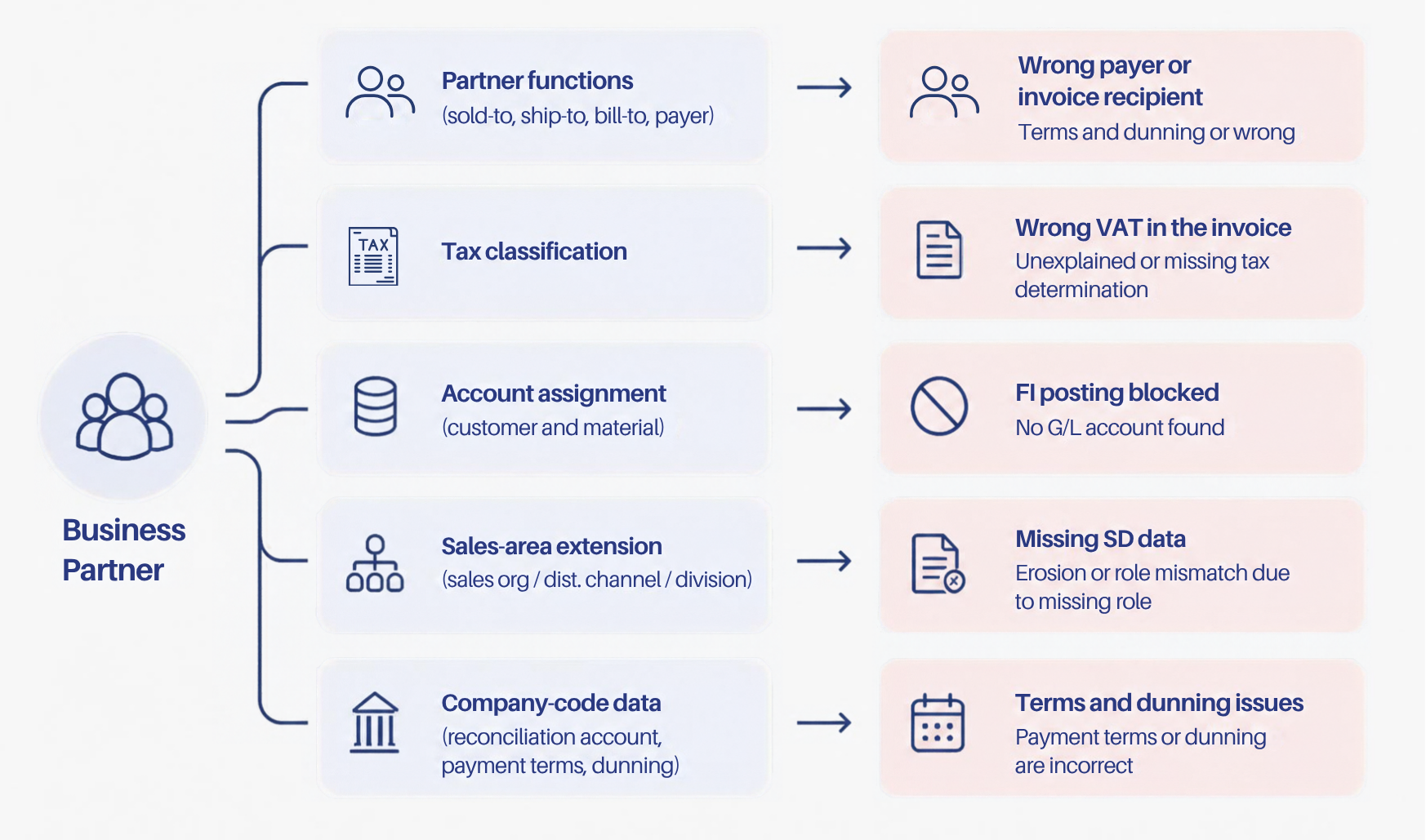
This points at the single most common structural defect: a BP that has the FI role but was never extended with the sales role for the relevant sales area. In S/4HANA the role largely drives field selection, which fields are required, optional or hidden, so if a role isn't assigned, the fields billing later depends on may simply never have been present at creation. They were never required fields due to the role assignment.
The process flaw underneath is that the BP is often created reactively, to unblock an order. The completeness billing depends on isn't enforced at the creation of the master data because the user creating the BP isn't the person who'll discover, weeks later, that a sales-area extension was missing.
The data consequence, aspect by aspect
Trace each symptom to the facet it reads, and the pattern becomes concrete.
Partner functions and the payer. The core SD partner functions, sold-to, ship-to, bill-to, payer, are defaulted from the customer-master partner data at sales-area level and copied onto each document through partner determination. Billing reads the payer for payment terms and dunning, and the bill-to for the invoice recipient. If the partner functions were set up so the payer defaults in a way that isn't actually intended every order for that customer can carry the wrong payer downstream, and it only becomes visible when someone questions why the terms or dunning look wrong. Nothing "failed"; the master data told the system to do exactly this.
Tax classification. Output tax on the invoice is determined through the tax condition, whose determination reads the customer's tax classification together with the material's. If the customer's tax classification is wrong or missing, which is common on newly created BPs and on records that came through a migration, determination can produce the wrong rate, or no valid tax condition at all. That surfaces at billing as a wrong VAT amount or, when the resulting tax code has no usable G/L assignment, as an error that blocks the accounting document. The customer thinks billing miscalculated tax. Often, the BP's tax classification did.
Release to accounting. This is usually the most expensive failure, because the revenue doesn't post at all. When a billing document is saved, and the billing type isn't set to block posting, the system attempts to create the FI document, and that step depends on account determination resolving a G/L account for each relevant condition. The inputs to that determination include master-data-driven fields such as the account-assignment groups on the customer and the material. When one of those is missing or wrong, the revenue condition can't find its account, the accounting interface errors, and the billing document sits unposted. The useful part for a practitioner: on a stuck invoice, the account-determination analysis built into the billing transaction shows which condition failed to find its account and the trail frequently ends at a master-data field rather than at broken configuration.
The migration multiplier. All of this tends to be sharper on a converted system. Customer Vendor Integration (CVI) keeps the Business Partner and the classic customer/vendor tables synchronised, and its quality requirements are strict, which is exactly why a brownfield conversion forces a master-data cleanup before it completes. When that cleanup is done to the minimum standard needed to pass migration rather than the standard billing actually needs, you can arrive on S/4HANA with BPs that are technically valid but functionally incomplete: roles not extended to every required sales area, partner functions not carried cleanly, links between the BP and the underlying customer records that don't fully reconcile, duplicates created by parallel number ranges. The first business process to systematically exercise all of that is billing, which is one reason post-go-live billing rework so often spikes, and gets misread as a billing-configuration problem when it's really a migration-completeness one.
The BP concentrates a lot of leverage in one shared object. A wrong field doesn't fail loudly initially, it propagates, correctly and silently, into every document that reads that aspect, and it surfaces far downstream from where it was created. That's why fixing invoices one at a time rarely reduces the volume, you're correcting outputs while the source record keeps producing new ones.
The fix: move validation to where the record is born
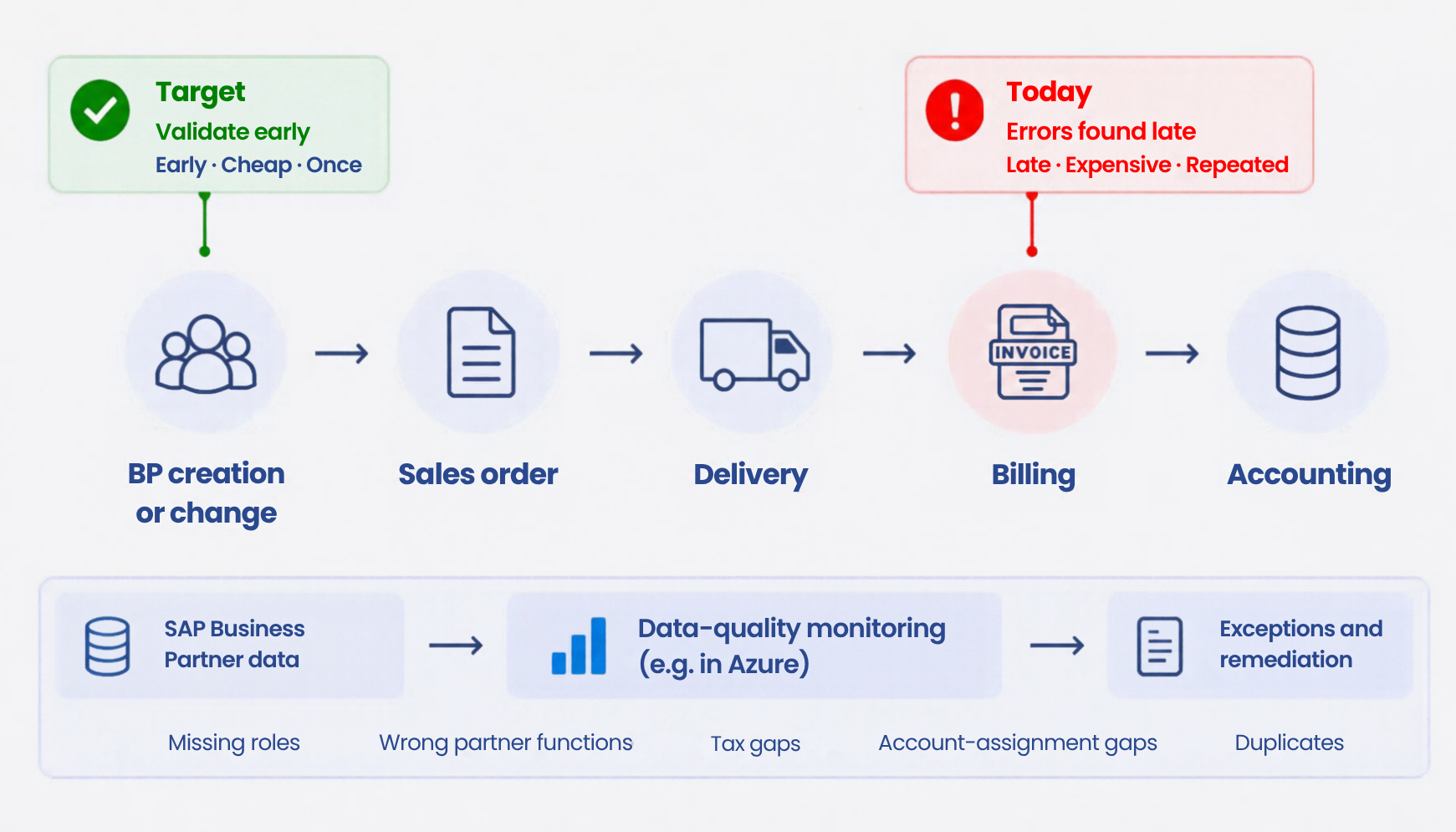
The intervention follows directly, move error detection upstream. From billing (late, expensive, one invoice at a time) to BP creation and change (early, cheap, once).
The first layer is governance at the source. The BP shouldn't be usable until the facets billing depends on are complete and internally consistent: the required roles present for every sales area the customer will transact in; partner functions that are deliberate rather than defaulted; a valid tax classification; the company-code and account-assignment fields populated; payment terms consistent between the order-relevant data and the payer. Much of this is less a technology problem than a decision, the BP is a governed object with an owner, enforced through field status, validation and a defined create/extend process, rather than hoping the record is right at the moment the invoice depends on it.
The second layer is proactive detection, because governance going forward doesn't clean the base you already have. Rather than discovering defective partners one failed invoice at a time, profile the BP population continuously and flag records that are incomplete, inconsistent or duplicated before they reach billing. In our work that typically means extracting the relevant Business Partner data, roles, partner functions, tax classification, account-assignment fields, out of SAP into Azure, modeling it into a data-quality view, and refreshing it so a defective BP shows up the day it's created, not on a stuck invoice weeks later. The same view exposes the distribution you can't otherwise see: which handful of records generate the bulk of the rework, so remediation targets the few that matter instead of the many invoices they produce.
The diagnostic
You can size this without a project. Take a month of billing exceptions, the documents stuck unposted, the tax failures, the credit notes for wrong VAT, the payer and terms disputes, and for each one, trace it back: run the account-determination analysis on the stuck ones, and follow the payer and tax fields back to the BP. Classify each as "billing/config" versus "master data." Most teams have never done this classification, and are surprised how far the balance tips toward the Business Partner.
This is how we work through SAP problems at Conactive: follow the symptom back to the process and the master data that produce it, and fix it at the source rather than the surface. If your billing exceptions trace back to the Business Partner more often than anyone wants to admit, that's a conversation worth having.
Continue the conversation with the author

Daniel Leal
Data & AI Infrastructure Consultant
Book a free 30-min call with Daniel and leave with clarity on your next step.
Pick your time in 60 seconds
