
Will your SAP payments still work as expected after 14 November 2026?
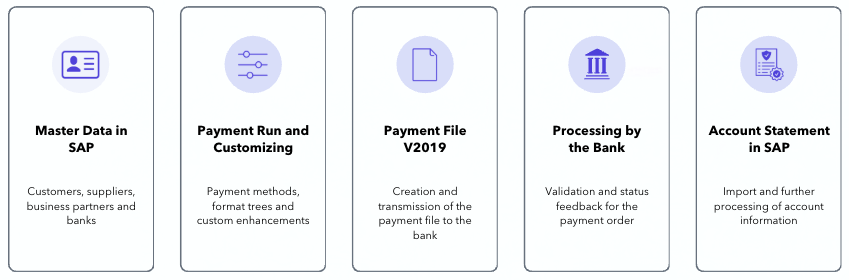
On 14 November 2026, an important transition period in Swiss payment traffic comes to an end. For companies running their payment processes through SAP, preparing for V2019 is not simply a matter of replacing one XML version with another.
The payment file sits in the middle of a much larger process. Master data determines what goes into it. SAP configuration and custom logic determine how it is created. Banks need to accept and process it. And the resulting information still needs to find its way back into SAP.
The practical question is therefore not simply “Have we updated pain.001?” but “Have we checked the payment process from beginning to end?”
Book a free SAP Readiness Check →
Download the Readiness Assessment →
60 minutes · Focused on your SAP landscape · No preparation required
Five checks before 14 November
There is no single SAP setting that determines whether an organisation is ready. The answer depends on the landscape.
For most SAP teams, however, five questions provide a useful place to start.
01 — Which pain.001 version is your SAP system generating?
The most visible change is also the easiest one to check. Swiss payment orders move from pain.001.001.03 to pain.001.001.09.
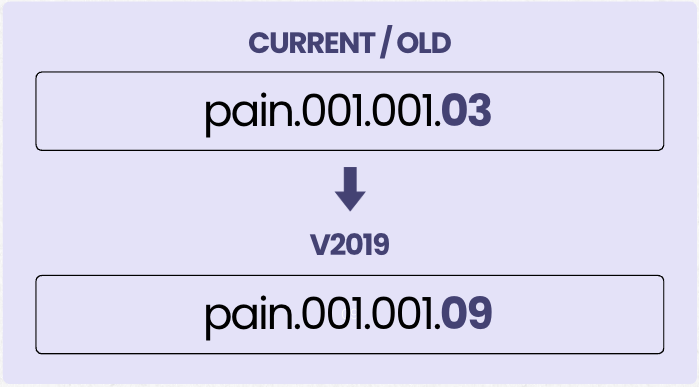
If your organisation uses standard payment formats, this may be relatively straightforward. If the payment process contains its own format trees, mappings or other adaptations, the question becomes more interesting:
What exactly is generating the productive payment file today? That is worth establishing before assuming that a technical update elsewhere has taken care of the process.
02 — What happens on the way back?
Payment projects naturally focus on the file being sent to the bank. But SAP also has to deal with what comes back.
The relevant camt.052, camt.053 and camt.054 messages move to V08. So a test that ends with a successfully generated payment file stops too early.

BANK → ACCOUNT STATEMENT → SAP
The better test follows the transaction further. Was the file accepted? Does the bank return the expected information? Can SAP import it? Does the downstream processing still behave correctly?
The outbound payment and the return path belong to the same test.
03 — A payment change can become a master-data problem
This is probably the less obvious part of the transition.
Purely unstructured addresses will no longer be permitted for payment orders. An address that has historically been sufficient for another business process may therefore not necessarily have the structure required for the new payment process.
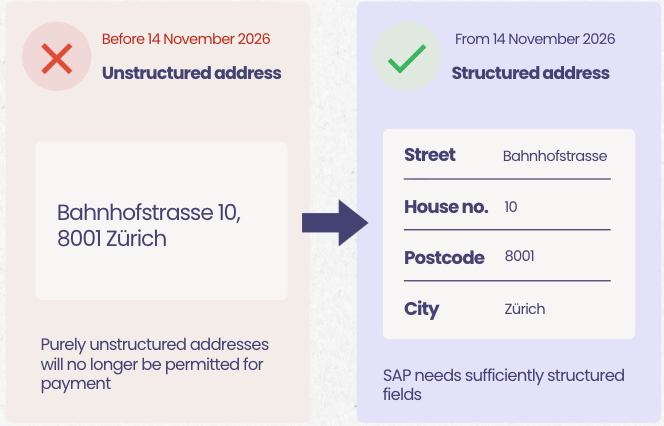
For example, an address stored simply as:
Bahnhofstrasse 10, 8001 Zürich
may need sufficiently structured information such as street, house number, postcode and city.
This is why V2019 should not be treated purely as a Finance or interface project. The investigation can lead back into customer, supplier or Business Partner master data. That changes who may need to be involved.
04 — Standard SAP may not be the difficult part
Older SAP payment landscapes often contain years of decisions that are not immediately visible from the standard configuration: format trees created for particular banks, mappings added for an interface, middleware transformations, SAP Notes, payment Customizing or customer-specific enhancements.
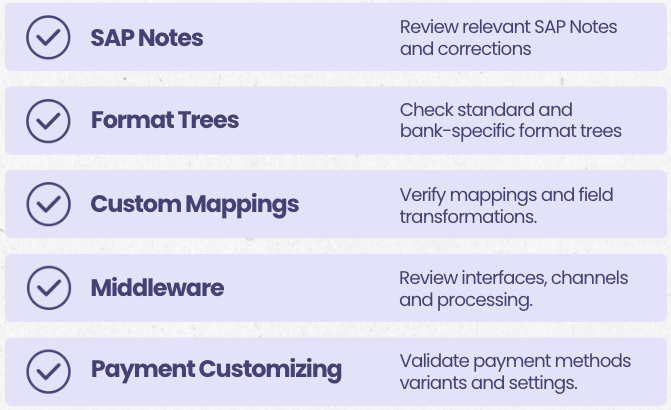
None of these is necessarily a problem. The risk is simply not knowing that it is there. A useful readiness review therefore asks not only whether the standard SAP components support V2019, but also what happens between the payment run and the file that actually reaches the bank.
05 — The real test is end-to-end
Eventually all four questions converge on one. Can you execute the payment process from SAP, through the bank, and back into SAP successfully?
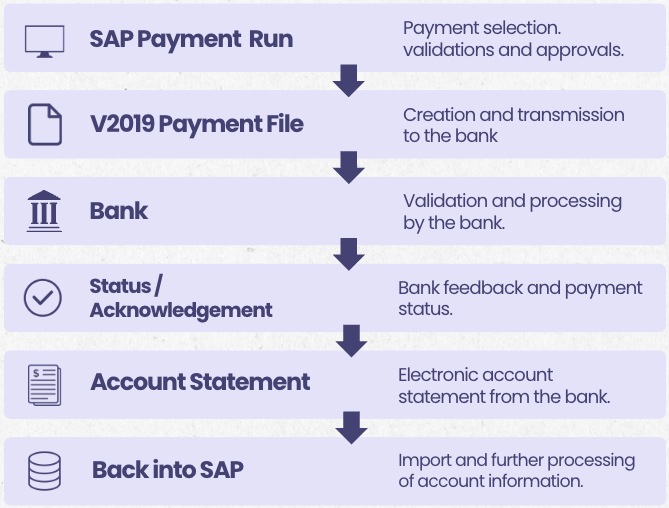
That means looking across master data, the payment run and Customizing, file generation, transmission, bank processing and feedback, and finally the electronic account statement.
How many of the five can you confidently answer?
If all five are clear, you are already in a good position.
If one or two produce a “we need to check that”, that is useful too. It tells you where uncertainty still exists before testing becomes time-critical.
And you don’t necessarily need to speak to us to start finding the answer.
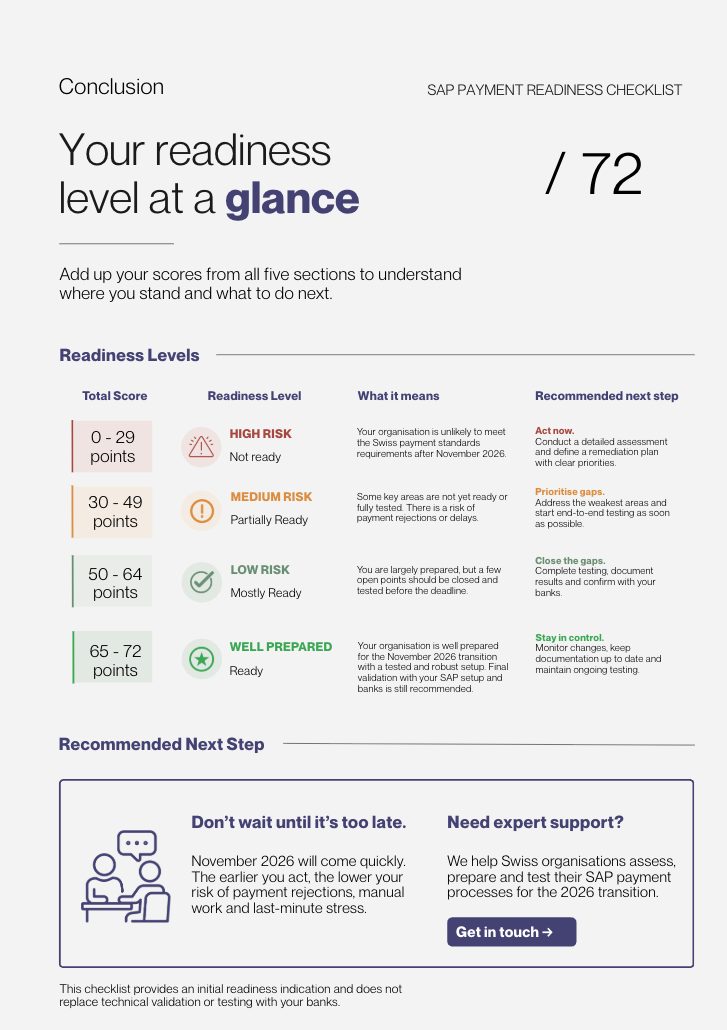
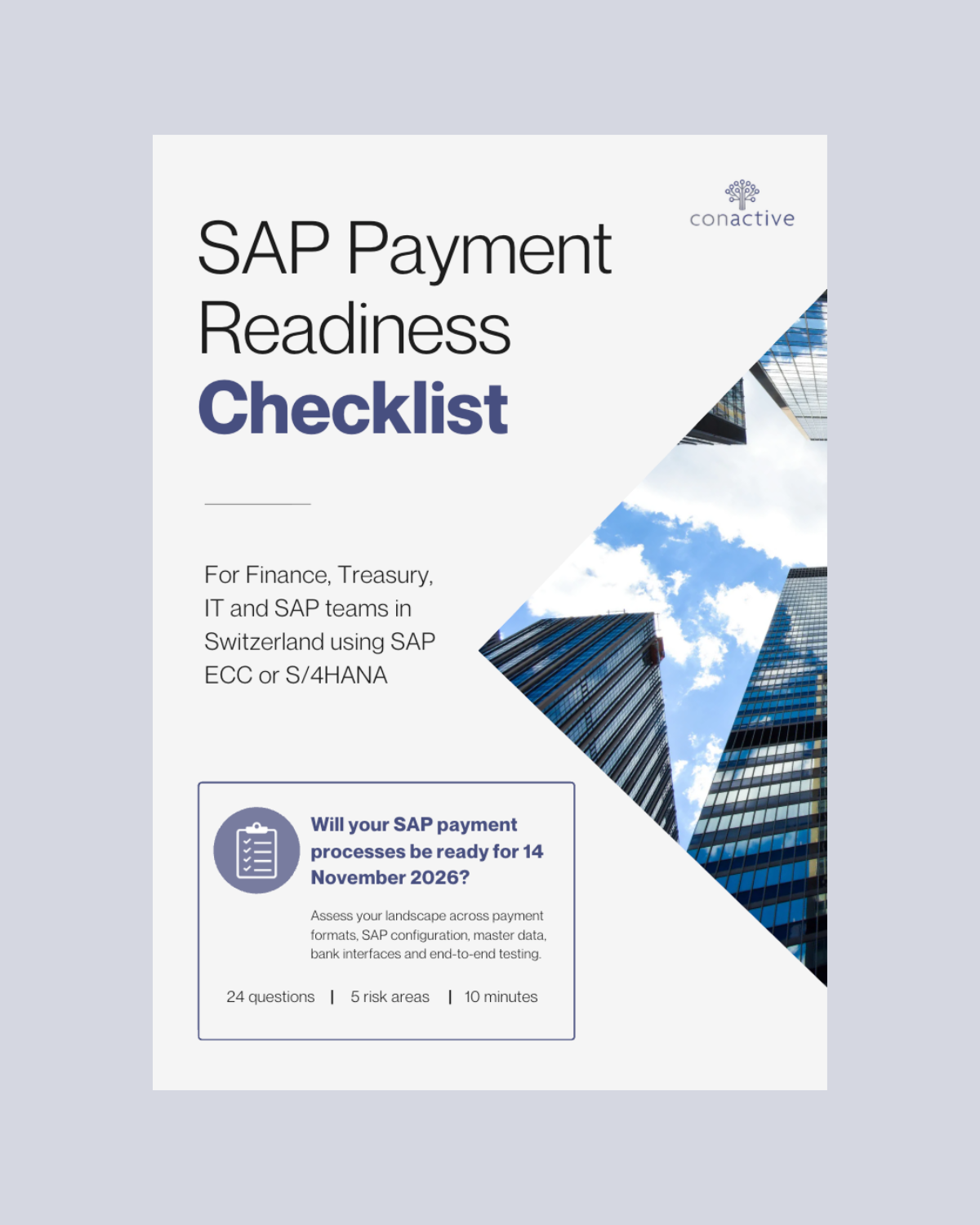
Want to assess your setup yourself first?
We have turned the questions above into a more detailed SAP ISO 20022 V2019 Readiness Assessment.
It is designed to help SAP, Finance and Treasury teams work systematically through their current payment landscape and identify areas that may deserve a closer look before 14 November 2026.
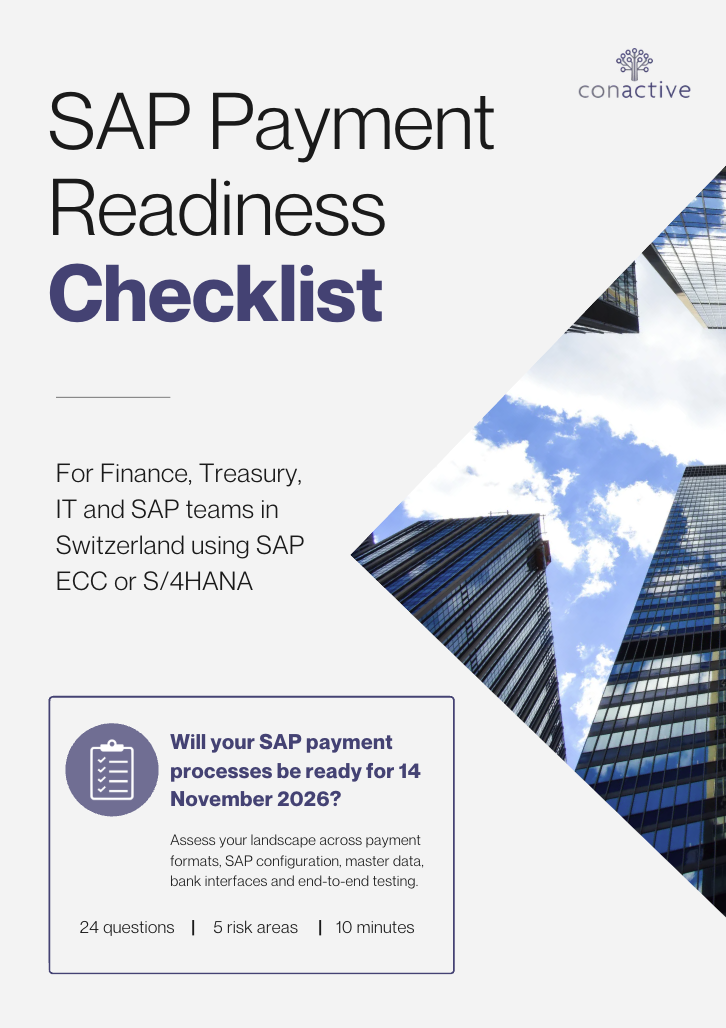
SAP ISO 20022 V2019 Readiness Assessment
Use the assessment internally to review your payment formats, account statements, master data, SAP configuration, interfaces and end-to-end testing approach.
Download the free assessment →
Prefer to go through it together?
If you would rather look at the questions with someone who works with SAP payment processes, we can apply the same thinking directly to your landscape.
This is exactly what our ISO 20022 V2019 SAP Readiness Check is designed to do.
Not sure you’ve covered all five?
We’ll check them with you.
In a focused 60-minute session, we go through your current SAP payment landscape together.
We establish what is already known, where assumptions still need to be verified, and which parts of the process deserve a closer look before the November transition.
This isn’t intended to be another presentation about ISO 20022. The purpose is to apply the five questions above to your actual SAP environment and leave with a clearer picture of what should happen next.
Free ISO 20022 V2019 SAP Readiness Check
60 minutes · Remote · Focused on your SAP landscape · No preparation required
What does the session actually look like?
We normally start by understanding the landscape: the SAP environment, banks, payment setup, relevant interfaces and what has already been done for V2019.
From there, we work through the areas that matter for that particular setup. For one organisation, the main question may be a custom payment format. For another, it may be address data or the processing of account statements. Where several teams are involved, simply establishing who owns which part of the end-to-end test can already be valuable.
By the end of the hour, the objective is not to produce a 30-page assessment. It is to distinguish between what appears covered, what still needs verification and what should happen next. The session is particularly relevant for teams working across SAP Finance, Treasury, SAP Application Management, Integration, Bank Communication and Master Data.
The payment file isn’t the payment process
This is perhaps the most important point in the entire transition. An SAP payment begins before the XML file exists and continues after the bank receives it. Master data provides the underlying customer, supplier, Business Partner and bank information. The payment run, payment methods, format trees and custom enhancements determine how SAP creates the payment. Interfaces and middleware may transform or transmit it. The bank then validates and processes the message before status information and account statements make their way back into SAP.
V2019 changes a message standard. Readiness belongs to the process around it. That is why we recommend looking at the change end-to-end rather than treating V2019 as an isolated XML-format update.
SAP expertise. Swiss context.
Conactive has been working with SAP environments in Switzerland for almost 30 years. Our work spans SAP applications, data, integrations and business processes. For this particular transition, that breadth matters because payment processing rarely ends at the boundary of a single SAP module.
Frequently asked questions
What happens on 14 November 2026?
The parallel phase ends and the relevant V2019 ISO 20022 message versions apply under the Swiss Payment Standards.
Which pain.001 version changes?
Payment orders move from pain.001.001.03 to pain.001.001.09.
Which camt messages are affected?
The relevant camt.052, camt.053 and camt.054 messages move to V08.
Is this only an SAP Finance issue?
Not necessarily. Depending on your landscape, the transition can involve Finance and Treasury, SAP Application Management, Integration and Middleware, Bank Communication, Master Data and process owners.
Does master data need to be reviewed?
It can. Purely unstructured addresses will no longer be permitted for payment orders, which makes payment-relevant address data one of the areas worth checking.
Is successfully generating a V2019 payment file enough?
Not by itself. The wider process also includes transmission, bank processing and feedback, account statements and subsequent processing back in SAP.
14 NOVEMBER 2026
Know what’s ready before testing reveals what’s missing.
If your SAP environment exchanges payment files with Swiss banks and there are still questions around any of the five areas above, there are two ways to start.
Want to investigate internally?
Download the SAP Readiness Assessment →
Want to go through your landscape together?
Download the Assessment
Continue the conversation with the author

Daniel Leal
Data & AI Infrastructure Consultant
Book a free 30-min call with Daniel and leave with clarity on your next step.
Pick your time in 60 seconds
