
When AI joins the team: What SAP Signavio now makes possible for your processes
Invoices that sit for too long. Orders that take detours. Approvals where nobody quite knows why they take so long. Most companies can feel that something in their processes isn’t working, but rarely know exactly where or why. SAP Signavio is designed to make exactly that visible, and the new AI makes it a great deal easier. We attended the meeting of the DSAG working group on SAP Signavio and summarise what is changing and what it means for businesses.
Based on: meeting of the DSAG working group on SAP Signavio on 27 October 2026, with contributions from Robert Hüfler and Philipp Walter (SAP Signavio). Features as of October 2026
1 · The foundation
From gut feeling to process reality
Almost every company has two versions of a process: the one in the handbook and the one that actually happens day to day. SAP Signavio brings the two together. With the Process Modeler, teams describe how a process should run. Process Intelligence uses data from the company’s systems to show how it really runs. This method is called process mining, and it works a bit like a GPS log: every order leaves a trail, and together these trails create an honest picture of every route, detour and waiting time. The Process Transformation Manager helps plan and track improvements, and the Process Collaboration Hub makes process knowledge accessible to everyone in the company.
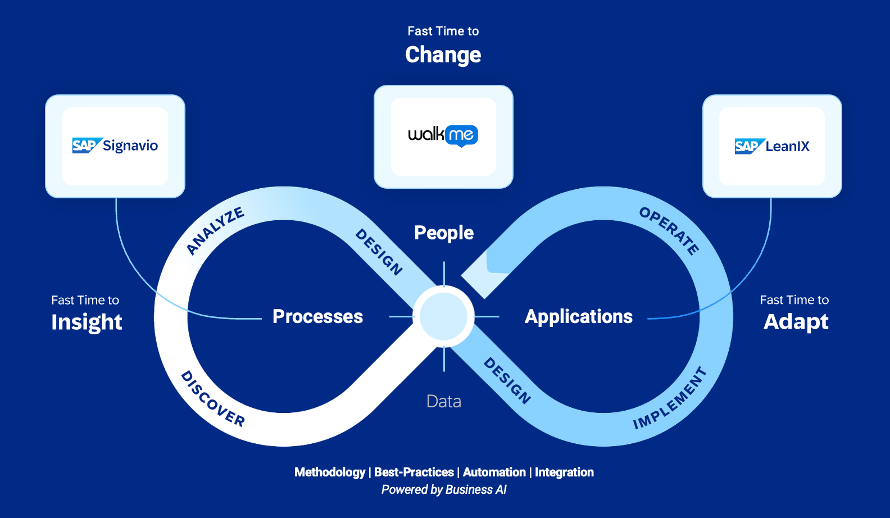
SAP has made the direction clear: AI is to support every step, from the first process model through analysis to putting improvements into practice. The aim is to relieve process teams of tedious manual work while improving quality and speed at the same time. How this fits into the bigger picture is shown in a graphic SAP calls the “Infinity Loop”.
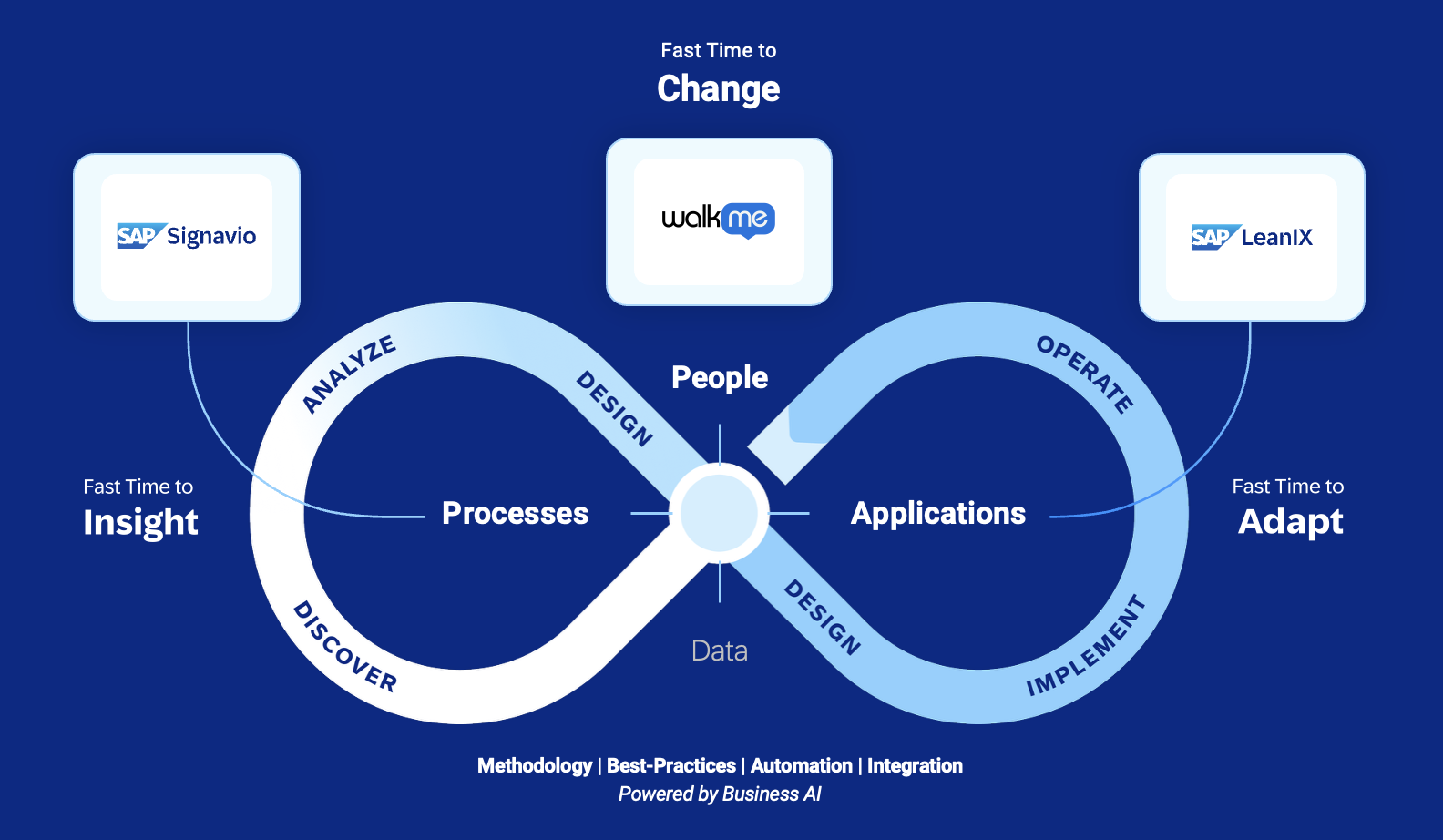
The idea behind the loop: Transformation is not a project with an end date, but a continuous cycle. Companies first understand how their processes really run today, design a better target state, implement it in their applications and work with it until the next round begins. At the centre are always people, processes, applications and data, because they only change together. Within this cycle, SAP Signavio provides the process view: spotting more quickly where things get stuck and making better-informed decisions about what should change.
2 · The principle
Helpers in the tool and agents with their own assignments
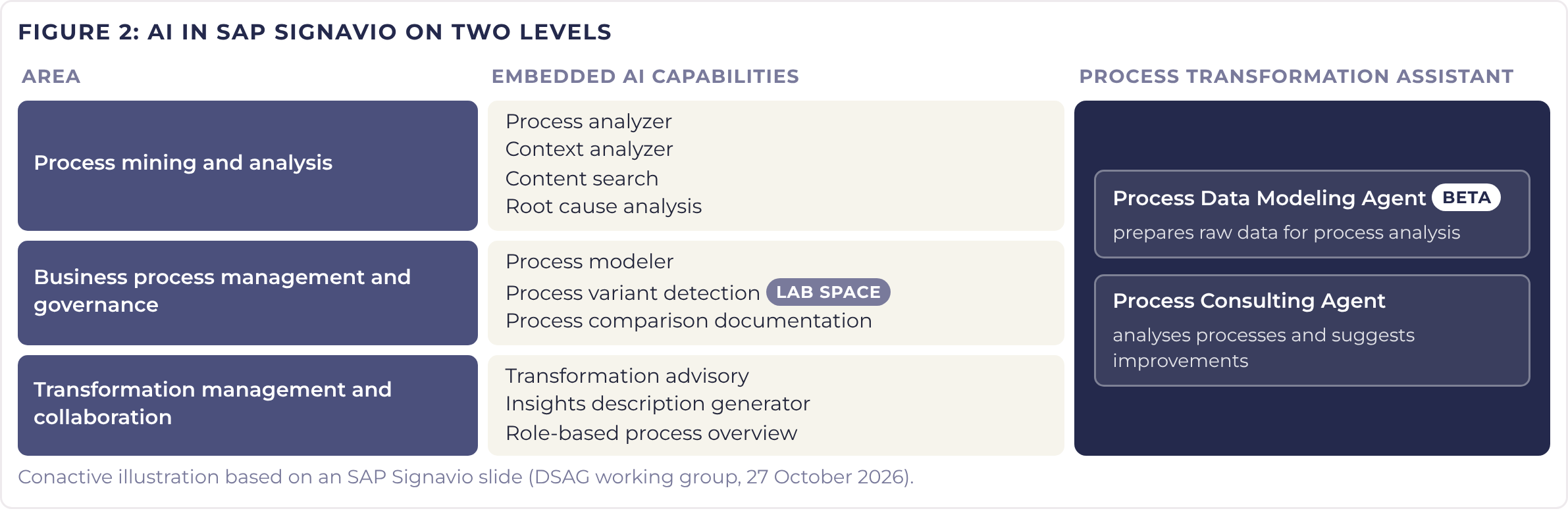
In SAP Signavio, AI is not a single feature but works on two levels. Most people know the first one from everyday life: embedded AI capabilities that help exactly where you are working, much like a spell checker or autocomplete. They suggest, summarise or explain, but you stay in the driving seat.
The second level is newer: the Process Transformation Assistant. It brings together what are known as AI agents. Instead of giving an agent a single command, you give it a task, much as you would a colleague. It plans the necessary steps, carries them out and comes back with a result for you to review and approve. We take a closer look at two of these agents in sections 4 and 5.
3 · The overview
What AI already takes on today
The list of AI capabilities is long, and most of them are already available. Capabilities labelled (Beta) or (Lab Space) are still being tested (more on this in section 6). Rather than listing each one, it is worth looking at the tasks they make easier:
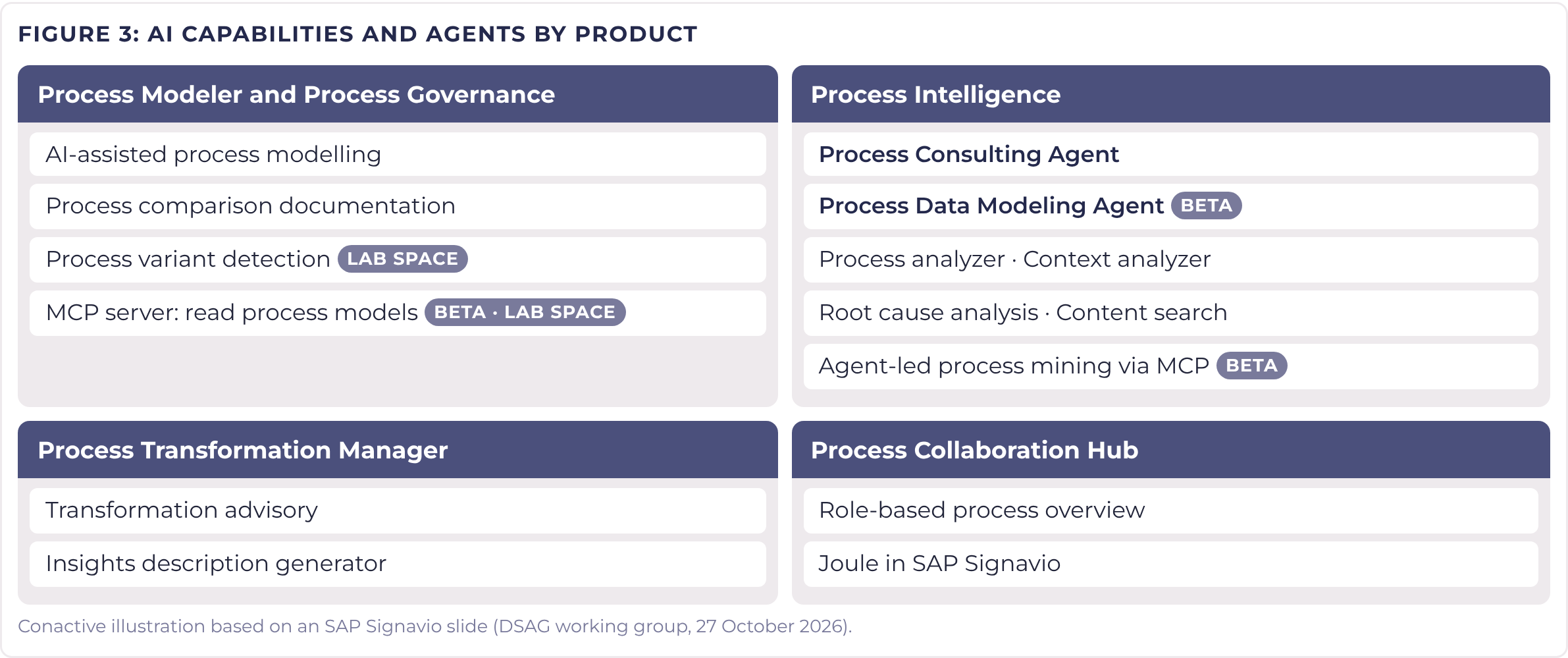
· Documenting processes without hours of drawing: A written description, a whiteboard sketch or a table becomes a first process draft that only needs refining. As you continue modelling, the AI makes suggestions and records what has changed between two versions.
· Asking the data questions as you would a colleague: Instead of building reports, you ask in plain language, for example where orders get held up the longest. The AI answers and explains the figures in context.
· Finding causes instead of fighting symptoms: Root cause analysis looks for the reasons behind delays and deviations, for example whether a particular site, supplier or process path is responsible.
· Planning change and making it understandable: The AI helps set up improvement initiatives, fills in missing details and tasks, and shows each role the processes that matter to it. With Joule, SAP’s AI assistant, you can navigate the process landscape conversationally.
· Open to other AI assistants (Beta): Through the new MCP server, external assistants such as Microsoft Copilot or Claude Code can also read process models from Signavio, read-only and with existing permissions. This makes process knowledge available wherever employees already work with AI.
4 · Process Data Modeling Agent (Beta)
From weeks to hours: The agent that prepares the data
Process mining promises quick answers. In practice, however, most of the effort often comes before the first analysis: a process’s data is scattered across many tables and systems. Before you can see how an order flows, someone has to define what counts as an event and how order, delivery and invoice are connected. That is work for specialists, and specialists are scarce.
The Process Data Modeling Agent is designed to take over this work. You hand it the raw data, describe in your own words what you want to analyse, and can add further context, such as a presentation about the process. It works with data from both SAP and non-SAP systems. According to SAP, this delivers in hours what used to take weeks.
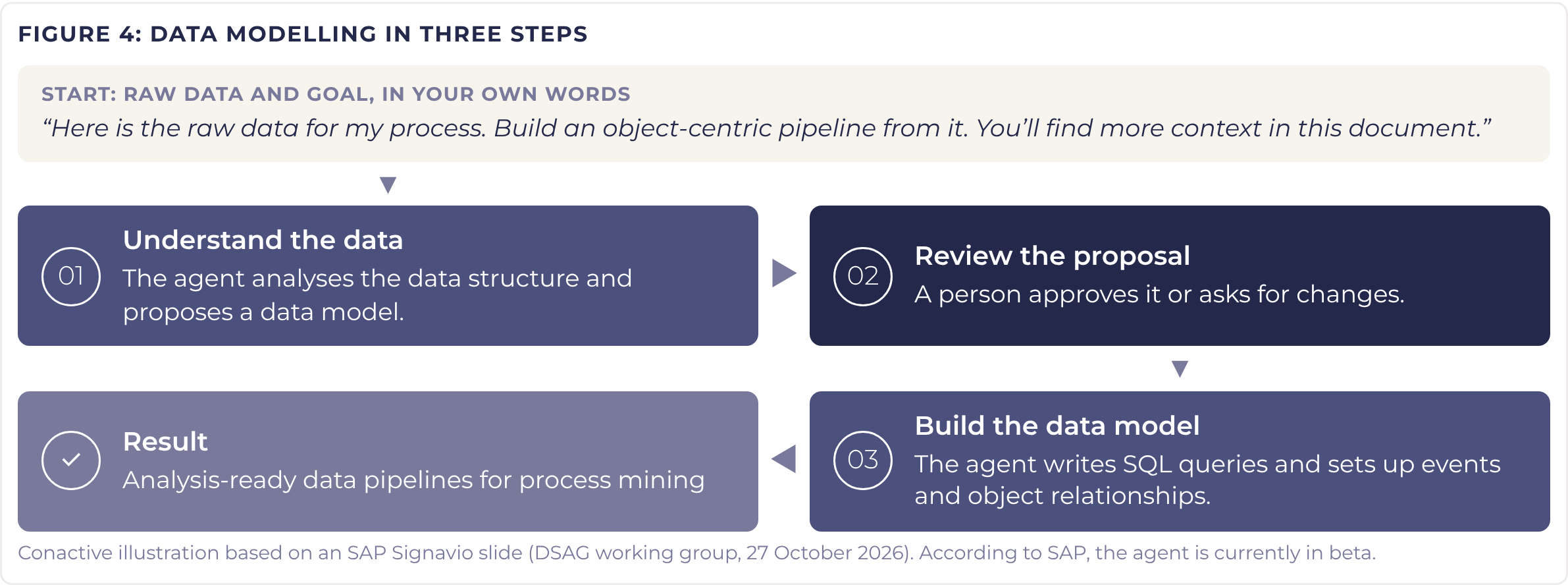
Step 2 is the crucial one: the agent builds nothing until a person has reviewed and approved its proposal. Business responsibility stays where the process knowledge is.
5 · Process Consulting Agent
A process consultant on call
Once the data is ready, the Process Consulting Agent comes into play. Think of it as an experienced consultant you can ask questions in plain language, for example:
POSSIBLE QUESTIONS FOR THE AGENT
“Why does order processing take longer at one site than at the others?” · “Which process variant causes the most rework?” · “How do we compare with other companies?”
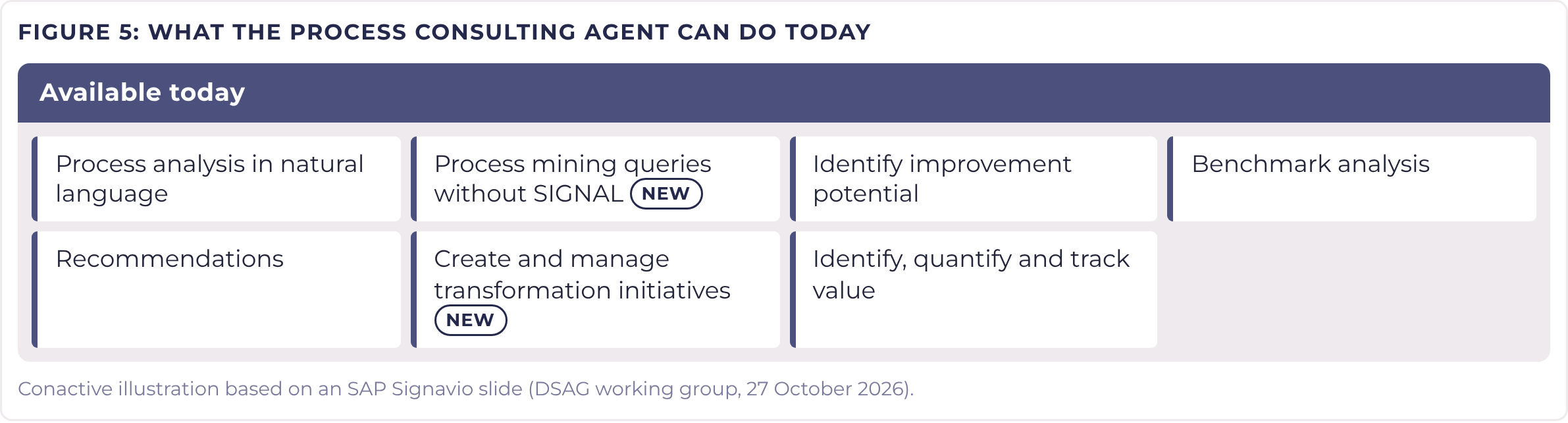
To answer them, the agent analyses cycle times, process variants, throughput and conformance with the target process. Until now, this required knowledge of SIGNAL, SAP Signavio’s query language, and therefore usually a specialist. Beyond that, it compares results with benchmarks, highlights improvement potential and makes recommendations. New: it can turn an improvement opportunity directly into a transformation initiative and estimate the value it will deliver. An insight thus becomes a concrete project whose benefits can also be checked later on.
6 · A look inside the workshop
Lab Space: Test tomorrow’s features today
A safe, free space to try out what comes next
One highlight of the meeting was the Lab Space. Here, customers can try out early ideas and new AI features from SAP Signavio before they are officially released. Testing uses real or sample data, kept separate from production systems, so there is no risk to day-to-day operations. However, the Lab Space can only be reached from within a licensed SAP Signavio workspace. Feedback goes straight to the teams developing the features. Or, as SAP puts it: what you try today helps decide what you will use tomorrow. Users thus become co-creators.
7 · The takeaway
What does this mean for your company?
AI in SAP Signavio is more than a faster tool. It lowers the barrier to engaging with your own processes, because you no longer necessarily need specialist knowledge to do so. Here are three thoughts we are taking away:
· Good process data becomes a must. AI agents can only advise as well as the process models and data they draw on. Clean processes are therefore no longer a documentation exercise but the foundation for any AI.
· Start with a real pain point. Rather than tackling everything at once, choose a process that is clearly struggling, for example because of long cycle times. That is where you will see most quickly what the AI can do.
· Have your say early instead of adapting later. Anyone who tests beta features in the Lab Space sees early on what is coming and can influence development with their own feedback.
Where do your processes get stuck the most, and which of these features would you try first? We look forward to hearing from you.
Continue the conversation with the author

Amina Yaremenko
Sales & Marketing at Conactive
Book a free 30-min call with Amina and leave with clarity on your next step.
Pick your time in 60 seconds
